Project ELEVAC | Transforming Campus Mobility.
Rerouting human traffic in busy universities and resolving physical infrastructure bottlenecks through real-time transparency and behavioural nudges.
Building for reality, not just the canvas.


© 2026 Designed & Documented by Akash Mounabhargav. All Rights Reserved.
Project ELEVAC | Transforming Campus Mobility.
Rerouting human traffic in busy universities and resolving physical infrastructure bottlenecks through real-time transparency and behavioural nudges.
Project Overview
The problem wasn't the elevators. It was the behavior around them.
Ground-level observation: not surveys, not interviews, actual counting revealed that nearly 60% of elevator users in the building were traveling fewer than five floors. High-capacity lifts designed for long-distance vertical movement were being consumed by micro-trips, creating peak-hour gridlock that couldn't be solved by adding more hardware. The infrastructure wasn't undersized. It was being used in a way nobody had explicitly designed for, and nobody had bothered to measure.
My role as PRODUCT DESIGNER
Research on stair-versus-elevator choice consistently shows that the primary driver isn't distance or effort, it's information. When people don't know how long they'll wait, they default to the elevator regardless of the floor. When wait time is visible and the staircase is framed as the faster option, behavior shifts measurably. Published behavioral interventions in university settings have demonstrated statistically significant increases in stair usage through targeted point-of-decision prompts alone, without any physical modifications to the building.
ELEVAC operationalizes that insight at the system level. Real-time occupancy and wait-time data eliminates the uncertainty that drives reflexive elevator use. Mobile-first incentives target lower-floor users specifically. The 60% generating the bottleneck, nudging them toward stairs by making the trade-off explicit and immediate. The intervention is entirely digital. No construction, no infrastructure cost, no architectural modification.
A physical infrastructure crisis, resolved through behavioral design and information transparency. The building didn't need to change. The feedback loop did.
Building for reality, not just the canvas.
© 2026 Designed & Documented by Akash Mounabhargav. All Rights Reserved.
More Case Studies.
More Case Studies.
More Case Studies.
Designing the ultimate survival watch
Designing the ultimate survival watch
Designing the ultimate survival watch
Wingman Pro Zero.
Wingman Pro Zero.
Wingman Pro Zero.

Changing facility audits forever
Changing facility audits forever
Changing facility audits forever
Custiv Audit Platfrom.
Custiv Audit Platfrom.
Custiv Audit Platfrom.
THE WRONG DIAGNOSIS.
When a campus elevator system is overcrowded, the instinctive diagnosis is infrastructure. More elevators. Faster motors. Bigger cabins. The problem, in this framing, is a supply problem - not enough vertical transport capacity for the volume of people who need it.
THE WRONG DIAGNOSIS.
When a campus elevator system is overcrowded, the instinctive diagnosis is infrastructure. More elevators. Faster motors. Bigger cabins. The problem, in this framing, is a supply problem - not enough vertical transport capacity for the volume of people who need it.
LIFT 2
LIFT 2
LIFT 3
LIFT 3
LIFT 6
LIFT 6
LIFT 5
LIFT 5
LIFT 4
LIFT 4
LIFT 1
LIFT 1
PES University had six elevators on the ground floor lobby, arranged in two banks of three facing each other, each with a maximum capacity of 20 people. That's 120 people per cycle. The hardware wasn't failing.
So why were students missing classes, arriving breathless, and making split-second decisions between waiting and running up ten flights of stairs every single day?
The answer wasn't in the elevator shaft. It was in the decision environment surrounding it, and it took field research to see it.

THE REAL CULPRIT ISN'T THE ELEVATOR. IT'S THE LOWER FLOORS.
The surveys and user interviews pointed to the usual suspects first: long wait times, overcrowded cabins, peak hour surges. 100% of respondents cited overcrowding as their primary pain point. 85.7% reported being in a rush often or very frequently. The numbers confirmed that the problem was real and widespread.
THE REAL CULPRIT ISN'T THE ELEVATOR. IT'S THE
LOWER FLOORS.
The surveys and user interviews pointed to the usual suspects first: long wait times, overcrowded cabins, peak hour surges. 100% of respondents cited overcrowding as their primary pain point. 85.7% reported being in a rush often or very frequently. The numbers confirmed that the problem was real and widespread.
81.5%
81.5%
Encounter Full Lifts
Encounter Full Lifts
Overcrowding Frequency
Overcrowding Frequency
Often
Often
Out of all respondents, 4 in 5 say full lifts are the norm, not the exception.
Out of all respondents, 4 in 5 say full lifts are the norm, not the exception.
18.5% occasionally · 0% rarely
18.5% occasionally · 0% rarely
85.7%
85.7%
In a rush at
peak hours
In a rush at
peak hours
Rush Frequency
Rush Frequency
Combined
Combined
46.4% very frequently, 39.3% often. Nearly no one arrives without urgency.
46.4% very frequently, 39.3% often. Nearly no one arrives without urgency.
14.3% occasionally · ~0% rarely
14.3% occasionally · ~0% rarely
Main challenge during peak hours
Main challenge during peak hours
Long wait times
Long wait times
55.6%
55.6%
Overcrowded cabins
Overcrowded cabins
44.4%
44.4%
other
other
~0%
~0%
Both point to a systemic capacity problem.
Both point to a systemic capacity problem.
Importance of Real-Time lift info
Importance of Real-Time lift info
IMPORTANT
IMPORTANT
51.9%
51.9%
NEUTRAL
NEUTRAL
44.4%
44.4%
NOT IMPORTANT
NOT IMPORTANT
3.7%
3.7%
96.3% see value - a clear intervention signal.
96.3% see value - a clear intervention signal.
The chain of causation
The chain of causation
Full Lifts
Full Lifts
81.5% face this daily
81.5% face this daily
Rush + No Info
Rush + No Info
85.7% rushing, blind
85.7% rushing, blind
Poor Decisions
Poor Decisions
No signal = Default choice
No signal = Default choice
ELEVAC
ELEVAC
Real-time signal fix
Real-time signal fix
But one finding sat underneath all of that, quieter and more specific.
Approximately 35 to 40% of elevator users at PES were traveling to floors below the 5th.
That one data point changed the entire diagnosis. The congestion wasn't caused by overwhelming demand from people who genuinely needed the elevator. It was caused by a significant portion of users choosing the elevator for trips that the stairs could handle in under two minutes. Floor 2. Floor 3. Floor 4. All of them adding to the queue, all of them occupying cabin space that someone heading to the 9th floor was waiting for.
The elevator wasn't broken. The demand was misallocated.
NOBODY WAS MAKING A BAD DECISION. THAT WAS THE PROBLEM.
Here's what makes this problem genuinely difficult: every single person choosing the elevator for the 3rd floor was making a perfectly rational decision.
But one finding sat underneath all of that, quieter and more specific.
Approximately 35 to 40% of elevator users at PES were traveling to floors below the 5th.
That one data point changed the entire diagnosis. The congestion wasn't caused by overwhelming demand from people who genuinely needed the elevator. It was caused by a significant portion of users choosing the elevator for trips that the stairs could handle in under two minutes. Floor 2. Floor 3. Floor 4. All of them adding to the queue, all of them occupying cabin space that someone heading to the 9th floor was waiting for.
The elevator wasn't broken. The demand was misallocated.
NOBODY WAS MAKING A BAD DECISION. THAT WAS THE PROBLEM.
Here's what makes this problem genuinely difficult: every single person choosing the elevator for the 3rd floor was making a perfectly rational decision.
Neutral
Neutral
Unhappy
Unhappy
Frustrated
Frustrated
Enters lobby
Enters lobby
Notices crowd
Notices crowd
Enters lift with the crowd
Enters lift with the crowd
Enters lift
Enters lift
Reaches 10th floor
Reaches 10th floor
Exits lift to make way for people
Exits lift to make way for people
Enters lift again
Enters lift again
Forced to exits lift due to overload
Forced to exits lift due to overload
Notices opposite lift open
Notices opposite lift open
Excited
Excited
Happy
Happy





No stairs are visible from the elevator lobby. There's no real-time information about how long the wait will be. There's no signal about how full the next cabin will be. There's no reason; social, informational, or incentive-based to make the harder choice. The rational move, given the information available, is to join the queue.
The congestion at PES wasn't the result of inconsiderate behavior. It was the emergent result of individually rational decisions made inside an environment that offered no corrective signal. Each person optimizing for themselves produced a collective outcome that was worse for everyone, including themselves.
This is a specific kind of systems failure. The hardware is adequate. The people are behaving reasonably. The environment between them is broken.
Fixing the elevator was never the right intervention. Fixing the decision environment was.
No stairs are visible from the elevator lobby. There's no real-time information about how long the wait will be. There's no signal about how full the next cabin will be. There's no reason; social, informational, or incentive-based to make the harder choice. The rational move, given the information available, is to join the queue.
The congestion at PES wasn't the result of inconsiderate behavior. It was the emergent result of individually rational decisions made inside an environment that offered no corrective signal. Each person optimizing for themselves produced a collective outcome that was worse for everyone, including themselves.
This is a specific kind of systems failure. The hardware is adequate. The people are behaving reasonably. The environment between them is broken.
Fixing the elevator was never the right intervention. Fixing the decision environment was.
THE INFORMATION VACUUM.
The research made the mechanism visible.
51.9% of respondents said real-time information on elevator status and wait times was crucial to their experience. That number is significant not because it's a majority, it's significant because it identifies exactly where the system was failing to self-correct. People weren't making poor decisions because they were careless. They were making poor decisions because the information required to make better ones simply didn't exist at the point where the decision happened.
Standing in the lobby, a user had no way to know which elevator would arrive next. No way to know how full it would be. No way to know whether the wait for a less crowded cabin would be 30 seconds or 4 minutes. No way to compare that against the time it would take to walk up two flights of stairs.
Every decision made in that lobby was a guess. And when everyone is guessing, the default wins, and the default is the elevator, because it requires no effort and carries no visible cost.
The intervention point was clear: close the information gap at the moment the decision is made, and the decision changes.
ELEVAC DOESN'T FIX THE ELEVATOR. IT FIXES THE DECISION.
ELEVAC is a two-surface system: information panels installed in the elevator lobby, and a companion mobile app for users approaching the lobby from elsewhere on campus.
Both surfaces answer the same question the user is silently asking every time they arrive at the lobby: should I wait, or should I take the stairs?
ELEVAC DOESN'T FIX THE ELEVATOR. IT FIXES THE DECISION.
ELEVAC is a two-surface system: information panels installed in the elevator lobby, and a companion mobile app for users approaching the lobby from elsewhere on campus.
Both surfaces answer the same question the user is silently asking every time they arrive at the lobby: should I wait, or should I take the stairs?

ETA: 1 min
2 persons
2
ETA: 1 min
12 persons
5
7 persons
ETA: 2 min
8


ETA: 1 min
2 persons
2
ETA: 1 min
12 persons
5
7 persons
ETA: 2 min
8

OUT OF SERVICE
ETA: 5 min
12 persons
8
ETA: 1 min
7 persons
4
OUT OF SERVICE
ETA: 5 min
12 persons
8
ETA: 1 min
7 persons
4
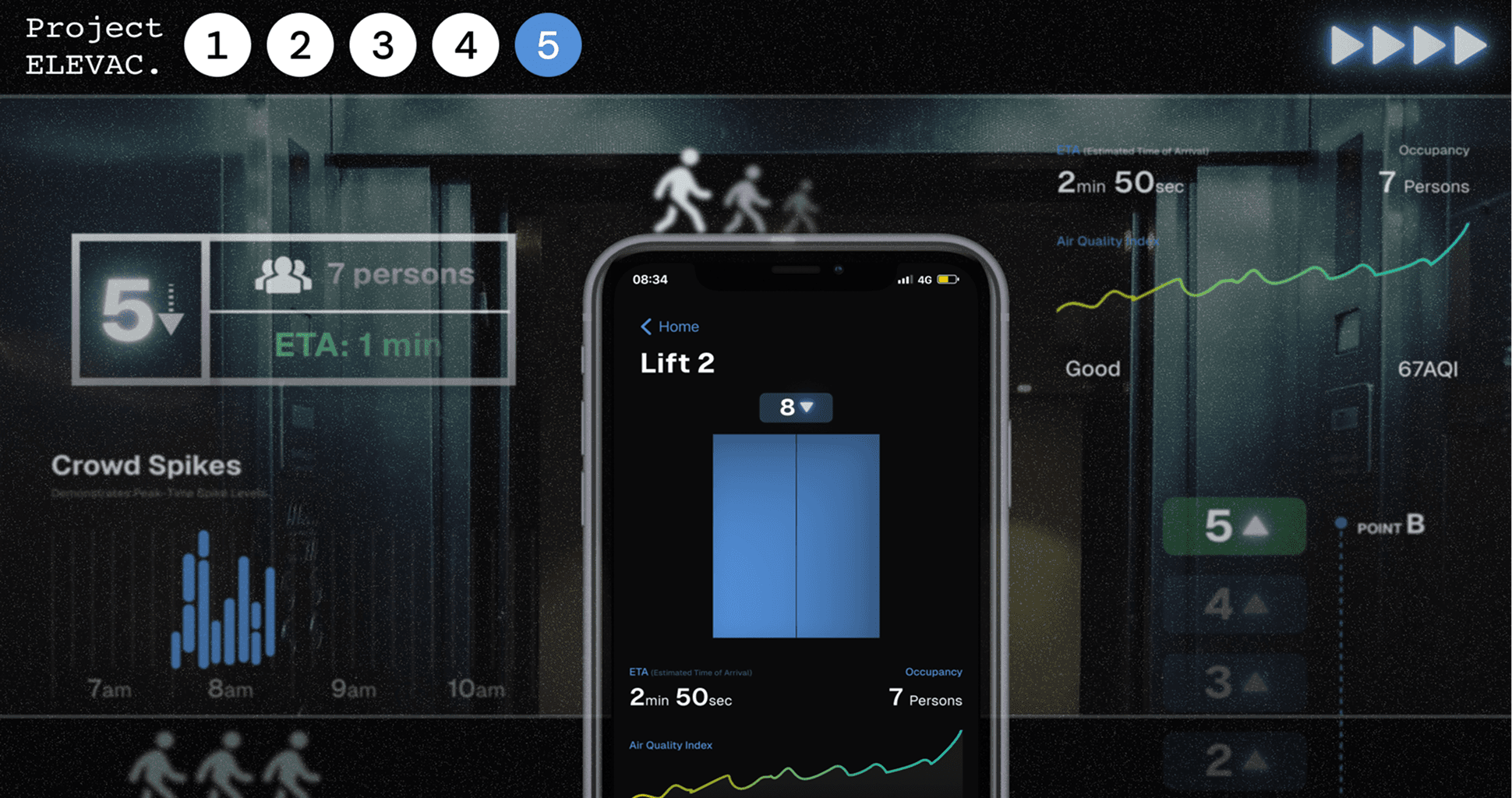
The panels display real-time occupancy status for each elevator, estimated arrival times, and current crowd levels; everything a user needs to make an informed choice in under three seconds. The mobile app mirrors this information for users who aren't physically in the lobby yet, allowing them to decide before they even arrive whether to route toward the elevator or the stairwell. No wasted time standing in a queue they could have avoided.
The panels display real-time occupancy status for each elevator, estimated arrival times, and current crowd levels; everything a user needs to make an informed choice in under three seconds. The mobile app mirrors this information for users who aren't physically in the lobby yet, allowing them to decide before they even arrive whether to route toward the elevator or the stairwell. No wasted time standing in a queue they could have avoided.


Lift Number
Lift Number
Lift Information
Lift Information
Set Alerts
Set Alerts
The design principle throughout was minimal cognitive load at maximum decision velocity. A person rushing to a 10 AM class has approximately two seconds of attention to spare at the elevator lobby. Every element of the interface is calibrated for that window. Occupancy is communicated visually, not numerically. ETA is displayed as a countdown, not a timestamp. The interface doesn't ask the user to think, it gives them one clear signal and gets out of the way.
No new elevators. No renovation. No infrastructure spend. The system works entirely within the existing physical environment by changing what users know when they need to know it.
The design principle throughout was minimal cognitive load at maximum decision velocity. A person rushing to a 10 AM class has approximately two seconds of attention to spare at the elevator lobby. Every element of the interface is calibrated for that window. Occupancy is communicated visually, not numerically. ETA is displayed as a countdown, not a timestamp. The interface doesn't ask the user to think, it gives them one clear signal and gets out of the way.
No new elevators. No renovation. No infrastructure spend. The system works entirely within the existing physical environment by changing what users know when they need to know it.
THE CANTEEN COUPON.
Information alone shifts behaviour at the margin. It helps people who were already uncertain make a better choice. But it doesn't reach the people who have already made up their mind, the habituated elevator users who take it to the 3rd floor every day without thinking, the same way they've always done.
For that segment, information isn't enough. You need a reason.
THE CANTEEN COUPON.
Information alone shifts behaviour at the margin. It helps people who were already uncertain make a better choice. But it doesn't reach the people who have already made up their mind, the habituated elevator users who take it to the 3rd floor every day without thinking, the same way they've always done.
For that segment, information isn't enough. You need a reason.
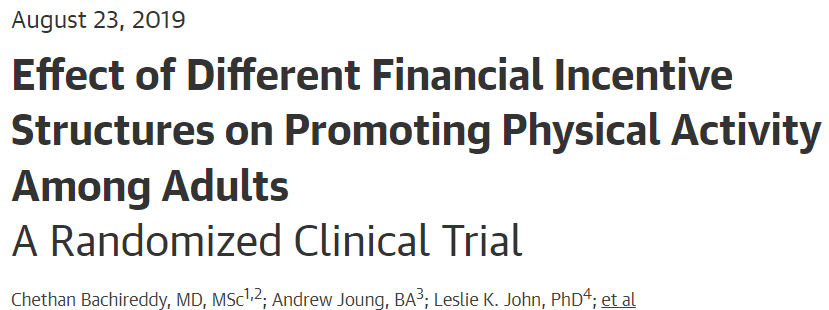
Research from the JAMA Network shows that financial incentives led to an 89% increase in physical activity among participants. The mechanism is well-documented: when a tangible benefit is attached to a behavior, the cost-benefit calculus shifts even for deeply habituated patterns. The behavior doesn't need to feel virtuous. It just needs to feel worth it.
Research from the JAMA Network shows that financial incentives led to an 89% increase in physical activity among participants. The mechanism is well-documented: when a tangible benefit is attached to a behavior, the cost-benefit calculus shifts even for deeply habituated patterns. The behavior doesn't need to feel virtuous. It just needs to feel worth it.
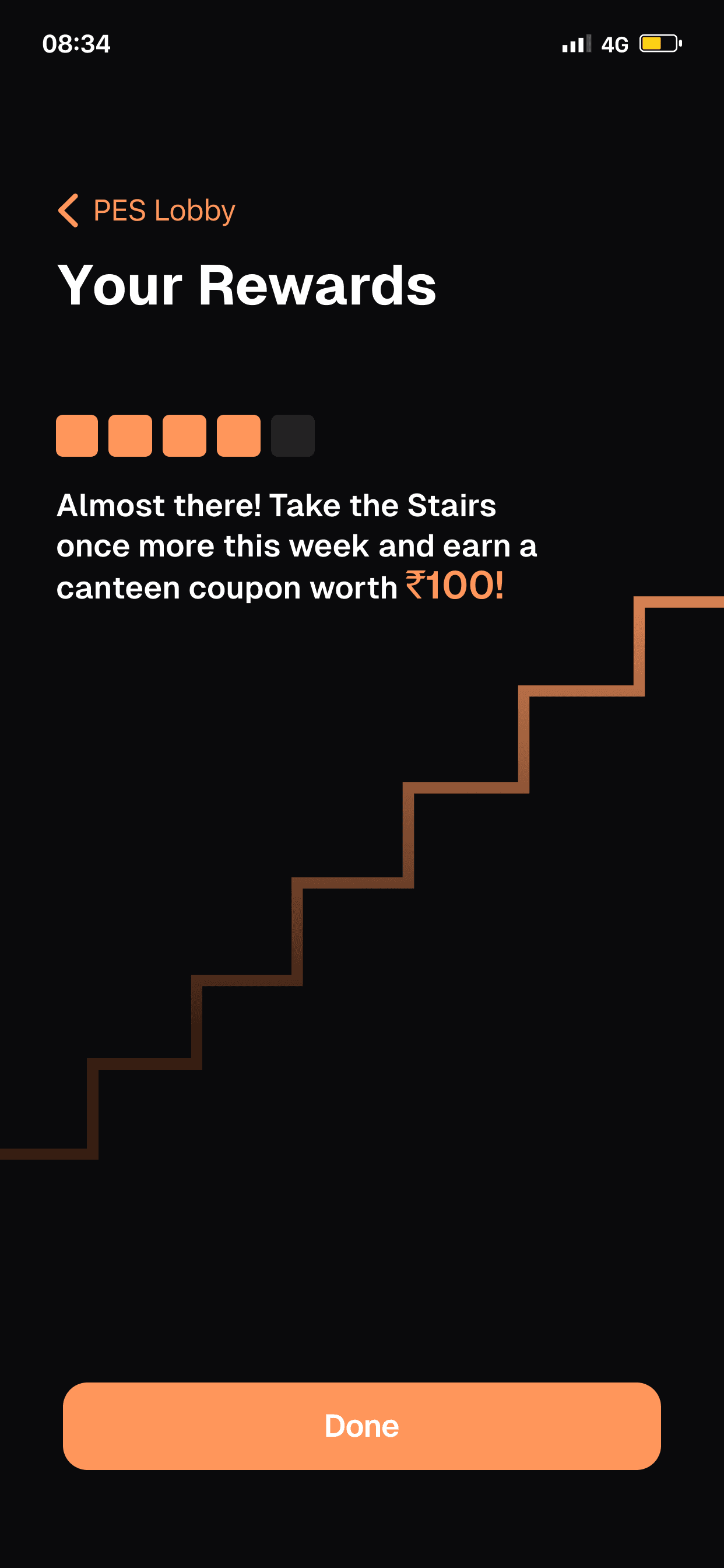
ELEVAC's incentive layer offers canteen coupons to students who choose the stairs during peak hours, tracked through the mobile app. The choice of incentive is deliberate. Canteen coupons are immediately relevant to a student population, redeemable on the same campus, and available at no significant operational cost to the institution. They don't require budget that a university doesn't have. They require coordination with a cafeteria that already exists.
The coupon isn't a gimmick. It's the signal that makes the staircase a real alternative rather than a sacrifice. Combined with real-time information that shows the elevator wait is four minutes, a canteen coupon tips the decision for the exact user that information alone couldn't reach.
ELEVAC's incentive layer offers canteen coupons to students who choose the stairs during peak hours, tracked through the mobile app. The choice of incentive is deliberate. Canteen coupons are immediately relevant to a student population, redeemable on the same campus, and available at no significant operational cost to the institution. They don't require budget that a university doesn't have. They require coordination with a cafeteria that already exists.
The coupon isn't a gimmick. It's the signal that makes the staircase a real alternative rather than a sacrifice. Combined with real-time information that shows the elevator wait is four minutes, a canteen coupon tips the decision for the exact user that information alone couldn't reach.
WHAT THIS PROJECT IS ACTUALLY ABOUT.
ELEVAC is not an elevator project.
It's a study in what happens when you remove the assumption that infrastructure is the problem and start asking what the decision environment is actually doing to the people inside it. The elevators at PES were adequate. The people using them were behaving rationally. The environment between them was producing an outcome that nobody wanted and everybody experienced.
The intervention was information, placed at the exact moment the decision happens, backed by an incentive designed for the exact population that information alone wouldn't move.
No construction. No capital expenditure. No disruption to the existing system. Just a correction to the signal environment that the existing system had never provided.
That's what behavioral design actually looks like when it's working, not nudging people toward better choices, but building an environment where better choices are simply the obvious ones.
WHAT THIS PROJECT IS ACTUALLY ABOUT.
ELEVAC is not an elevator project.
It's a study in what happens when you remove the assumption that infrastructure is the problem and start asking what the decision environment is actually doing to the people inside it. The elevators at PES were adequate. The people using them were behaving rationally. The environment between them was producing an outcome that nobody wanted and everybody experienced.
The intervention was information, placed at the exact moment the decision happens, backed by an incentive designed for the exact population that information alone wouldn't move.
No construction. No capital expenditure. No disruption to the existing system. Just a correction to the signal environment that the existing system had never provided.
That's what behavioral design actually looks like when it's working, not nudging people toward better choices, but building an environment where better choices are simply the obvious ones.